数据结构算法C语言实现(二十七)--- 7.2图的遍历
一.简述
栈与队列,DFS与BFS。仅以连接表为例实现。
二.头文件
BFS要用到的头文件
 1 //3_4_part1.h
 2 /**
 3 author:zhaoyu
 4 email:zhaoyu1995.com@gmail.com
 5 date:2016-6-9
 6     2016-6-25修改版,针对第七章
 7 note:realize my textbook <<数据结构(C语言版)>>
 8 */
 9 //Page 64
10 #include <cstdio>
11 #include "head.h"
12 #define QElemType int
13 //----循环队列:队列的顺序存储结构----
14 #define MAXQSIZE 10 //最大队列长度
15 typedef struct{
16     QElemType *base;
17     int front;
18     int rear;
19 }SqQueue;
20 //----循环队列的基本操作说明及实现----
21 Status InitQueue(SqQueue &Q)
22 {
23     //构造一个空队列 Q
24     Q.base = (QElemType *)malloc(MAXQSIZE*sizeof(QElemType));
25     if (!Q.base)
26     {
27         exit(OVERFLOW);
28     }
29     Q.front = Q.rear = 0;
30     return OK;
31 }
32 int QueueLength(SqQueue Q)
33 {
34     //返回 Q 的元素个数,即队列的长度
35     return (Q.rear - Q.front + MAXQSIZE) % MAXQSIZE;
36 }
37 Status EnQueue(SqQueue &Q, QElemType e)
38 {
39     //插入元素 e 为 Q 的新的队尾元素
40     if ((Q.rear+1)%MAXQSIZE == Q.front)
41     {
42         return ERROR;//队列满
43     }
44     Q.base[Q.rear] = e;
45     Q.rear = (Q.rear+1)%MAXQSIZE;
46     return OK;
47 }
48 Status DeQueue(SqQueue &Q, QElemType &e)
49 {
50     //若队列不空,则删除 Q 的队列头元素,用 e 返回其值,
51     //并返回 OK,否则返回 ERROR
52     if (Q.front == Q.rear)
53     {
54         return ERROR;
55     }
56     e = Q.base[Q.front];
57     Q.front = (Q.front+1)%MAXQSIZE;
58     return OK;
59 }
60 Status QueueEmpty(SqQueue Q)
61 {
62     if (Q.front == Q.rear)
63     {
64         return TRUE;
65     }
66     else
67     {
68         return FALSE;
69     }
70 }
71 void PrintQueue(SqQueue Q)
72 {
73     int cnt = Q.front;
74     if (Q.front == Q.rear)
75     {
76         printf("void\n");
77         return;
78     }
79     while ((cnt+1)%MAXQSIZE != Q.rear)
80     {
81         //printf("%d\t%d\n",Q.base[cnt++], cnt);输出好奇怪
82         printf("%d\t", Q.base[cnt]);
83         cnt++;
84     }
85     printf("%d\n", Q.base[cnt]);
86 }
3_4_part2.h
存储结构用到的头文件
  1 //filename:7_2_part2.h
  2 //date:2016-6-20
  3 //author:zhaoyu
  4 //note:
  5 //----图的邻接表存储表示----
  6 #include "head.h"
  7 #include <cstdio>
  8 #include <cstdlib>
  9 #include <cstring>
 10 #define MAX_VERTEX_NUM 20
 11 #define VertexType int
 12 #define InfoType char
 13 #define Graph ALGraph
 14 typedef struct ArcNode{
 15     int adjvex;//该弧所指向的顶点位置
 16     struct ArcNode *nextarc;//指向下一条弧的指针
 17     InfoType *info;//该弧相关信息的指针
 18 }ArcNode;
 19 typedef struct VNode{
 20     VertexType data;//顶点信息
 21     ArcNode *firstarc;//指向第一条依附该顶点的弧的指针
 22 }VNode, AdjList[MAX_VERTEX_NUM];
 23 typedef struct {
 24     AdjList vertices;
 25     int vexnum, arcnum;
 26     int kind;
 27 }ALGraph;
 28
 29 void AddNode(ALGraph &G, int v, int w)
 30 {
 31     G.vertices[v].data = v;
 32     if (NULL == G.vertices[v].firstarc)
 33     {
 34         G.vertices[v].firstarc = (ArcNode *)malloc(sizeof(ArcNode));
 35         G.vertices[v].firstarc->nextarc = NULL;
 36         G.vertices[v].firstarc->adjvex = w;
 37         G.vertices[v].firstarc->info = NULL;
 38         return;
 39     }
 40     ArcNode *temp = G.vertices[v].firstarc;
 41     while (temp->nextarc)
 42     {
 43         temp = temp->nextarc;
 44     }
 45     ArcNode *move = (ArcNode *)malloc(sizeof(ArcNode));
 46     move->nextarc = NULL;
 47     move->adjvex = w;
 48     move->info = NULL;
 49     temp->nextarc = move;
 50 }
 51 void CreateALGraph(ALGraph &G)
 52 {
 53     for (int i = 0; i < MAX_VERTEX_NUM; i++)
 54     {
 55         G.vertices[i].firstarc = NULL;
 56     }
 57     printf("input vexnum and arcnum(1~MAX):\n");
 58     scanf("%d%d", &G.vexnum, &G.arcnum);
 59     int v, w;
 60     for (int i = 0; i < G.arcnum; i++)
 61     {
 62         scanf("%d%d", &v, &w);
 63         AddNode(G, v, w);
 64         AddNode(G, w, v);
 65     }
 66 }
 67 Status Visit(int v)
 68 {
 69     printf("%d->", v);
 70 }
 71 int FirstAdjVex(ALGraph G, int v)
 72 {
 73     if (NULL != G.vertices[v].firstarc)
 74     {
 75         return G.vertices[v].firstarc->adjvex;
 76     }
 77     else
 78     {
 79         return -1;
 80     }
 81 }
 82 int NextAdjVex(Graph G, int v, int w)
 83 {
 84     if (NULL != G.vertices[v].firstarc)
 85     {
 86         ArcNode *temp = G.vertices[v].firstarc;
 87         while (temp != NULL)
 88         {
 89             if (temp->adjvex == w)
 90             {
 91                 if (NULL != temp->nextarc)
 92                 {
 93                     return temp->nextarc->adjvex;
 94                 }
 95                 else
 96                 {
 97                     return -1;
 98                 }
 99             }
100             temp = temp->nextarc;
101         }
102         return -1;
103     }
104     else
105     {
106         return -1;
107     }
108 }
7_2_part2.h
其他
 1 //filename:7_3.h
 2 //date:2016-6-25
 3 //author:
 4 //note:仅以邻接表为例
 5 #include "7_2_part2.h"
 6 #include "3_4_part2.h"
 7 #define Boolean int
 8 #define MAX MAX_VERTEX_NUM
 9 Boolean visited[MAX];//访问标志数组
10 Status (* VisitFunc)(int v);//函数变量
11 /**
12 algorithm 7.5
13 */
14 void DFS(Graph G, int v)
15 {
16     visited[v] = TRUE;
17     VisitFunc(v);//访问第 v 个结点
18     for (int w = FirstAdjVex(G, v); w >= 0; w = NextAdjVex(G, v, w))
19     {
20         if (!visited[w])
21         {
22             DFS(G, w);//对 v 的尚未访问的邻接顶点,递归调用 DFS
23         }
24     }
25 }
26 /**
27 algorithm 7.4
28 */
29 void DFSTraverse(Graph G, Status (* Visit)(int v))
30 {//对图 G 做深度游优先遍历
31     VisitFunc = Visit;//使用全局变量VisitFunc,使DFS不必设函数指针参数
32     for (int v = 0; v < G.vexnum; ++v)
33     {
34         visited[v] = FALSE;
35     }
36     for (int v = 0; v < G.vexnum; ++v)
37     {
38         if (!visited[v])
39         {
40             DFS(G, v);
41         }
42     }
43     printf("\b\b  \n");
44 }
45
46 void BFSTraverse(Graph G, Status (* Visit)(int v))
47 {//按广度优先非递归遍历图 G,使用辅助队列 Q 和访问标志数组 visited
48     for (int v = 0; v < G.vexnum; ++v)
49     {
50         visited[v] = FALSE;
51     }
52     SqQueue Q;
53     InitQueue(Q);//置空的辅助队列 Q
54     for (int v = 0; v < G.vexnum; ++v)
55     {
56         if (!visited[v])//v 尚未访问
57         {
58             visited[v] = TRUE;
59             Visit(v);
60             EnQueue(Q, v);// v 入队列
61             while (!QueueEmpty(Q))
62             {
63                 int u = -1;
64                 DeQueue(Q, u);//队头元素出队并置为 u
65                 for (int w = FirstAdjVex(G, u); w >= 0; w = NextAdjVex(G, u, w))
66                 {//w 为 u 尚未访问的邻居节点
67                     if (!visited[w])
68                     {
69                         visited[w] = TRUE;
70                         Visit(w);
71                         EnQueue(Q, w);
72                     }
73                 }
74             }
75         }
76     }
77     printf("\b\b  \n");
78 }
7_3.h
三.CPP文件
 1 #include "7_3.h"
 2 int main(int argc, char const *argv[])
 3 {
 4     ALGraph G;
 5     CreateALGraph(G);
 6     printf("DFS Traverse\t");
 7     DFSTraverse(G, Visit);
 8     printf("BFS Traverse\t");
 9     BFSTraverse(G, Visit);
10     return 0;
11 }
7_3.cpp
四.测试
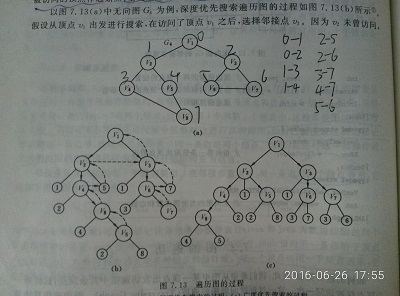
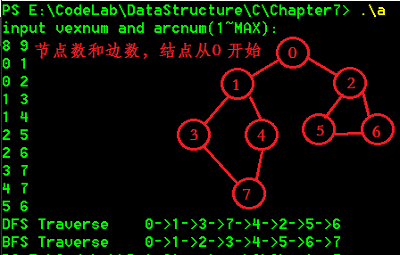
以书本上的图为例